gergo d. farkas
rascal
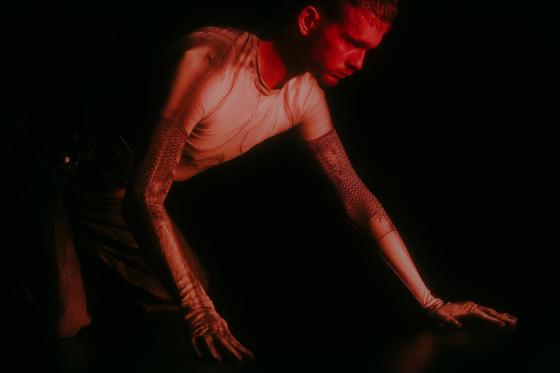
With the dance solo rascal, gergo d. farkas takes audiences through a place of continuous emergence; a nebulous, yet sensual world where bodies feel a little more and love a little harder. In this somatically cultivated fantasy, an array of beings come and go but never arrive, offering a disorienting journey between ins and outs, thens and nows, heres and elsewheres as they roam between body worlding and world bodying.


A sensual dance from passivity towards passion, this journey to other spheres makes for an encounter between the human and the non-human: gergo d. farkas’s rascal drifts through a place of continuous emergence; a nebulous, yet sensual world where bodies feel a little more and love a little harder. In this somatically cultivated fantasy disguised as a dance solo, an array of beings come and go but never arrive. rascal is the third piece drawing on elements of organ-ing, a choreographic research and movement practice devised by gergo d. farkas where fiction intertwines with the body’s pre-existing narratives to bring forth an array of fantasies that weave together the felt sense of the body. Through organ-ing, gergo d. farkas nurtures uncharted organs in the body – formations with vague anatomical functions and strong poetic agencies. Accompanied by Márton Csernovszky’s microtonally twisted spatial sound compositions, rascal carefully (mis)guides the spectator through contorted landscapes composed by visual artist duo Lőrinc Borsos and lighting designer Leo Kuraite. rascal is moved by mysterious photosensitive skin cells, mischievous guts, and hyperstimulated vestibular systems. A porous dance (re)connecting passivity with passion.
gergo d. farkas (they/them) is a gathering of cells with a passion for choreography, dance, romance and mischief. Being lost in Vienna, Budapest, Stockholm, or somewhere in between, they dream of belonging to sensual spaces where not only humans are invited to dance. Their choreographic work has been presented in venues and festivals such as, among others, Zürcher Theater Spektakel (CH), Spring Forward Festival (GR, IT), Imagetanz (AT), TQW’s RAKETE (AT), Trafó House of Contemporary Arts (HU), under500 Festival (HU), Dansehallerne (DK), MDT Moderna Dansteatern (SE), Réplika Teatro (SE), Open House Festival (CY), MDT Legacy Festival (NL), and Dansmakers Amsterdam (NL). Their first work Deep Fake was part of the Aerowaves Twenty22 selection and nominated for the ZKB Acknowledgement Prize (CH), while their second work babes was selected for Aerowaves Twenty25 and nominated for the Rudolf Lábán Award (HU).
Team
Márton Csernovszky is a musician and sound designer with a diverse artistic background, having studied jazz bass guitar, classical guitar and composition. He has been involved in various music projects, including the free jazz band The Best Bad Trip and his solo electronic project OOO. Márton's sound design contributions span numerous stage plays, including works by Adél Juhász and gergo d. farkas.
Lőrinc Borsos (they/them) are an artist duo. Lilla Lőrinc (she/her) and János Borsos (he/him) have been collaborating as Lőrinc Borsos since 2008. The name covers an entity with its own creative consciousness. Their age is currently 17 years. Their gender, sexual orientation and intellect are equally characterized by bipolarity. The basis of their existence is the coexistence of extremities, but their actual goal is the solution of duality. They are vitalized by transition. Their spiritual nutriment is paradox, the intersections of contradictory ideologies. The typical case of fall between two stools but the choice of the floor is self-imposed. The artist aims at the glimpse of the greater whole: instead of choosing a part, they are excited about the relation of the parts to the whole. They despise hierarchy and the social divide and exclusion created in its wake.
Sebastian Starlinger / Sebbe (he/him) aka Sebbe is a Vienna-based editor, social media manager and production manager. His biggest projects so far as a contributor are the web talk FIVE SOULS ordered by German public broadcaster SWR, as well as smaller projects in queer entertainment for Netflix (Queer-Eye-Talk and The Wheel Deal). His latest projects include social media management for the 2023 ImPulsTanz Festival Performers Lau Lukkarila and Luca Bonamore, producing last year's performance Latente by Martina De Dominicis and successfully leading a crowdfunding campaign for the post-production of the documentary AUSTROSCHWARZ by Mwita Mataro and Helmut Karner. Sebbe's focus lies on queer, feminist and progressive projects and environments where his sensitivity and emotionality are applied.
Claire Lefèvre (she/her)is a femme choreographer, insomniac writer and reality TV enthusiast currently based in Vienna, Austria. She likes to think of herself as a hostess, welcoming collaborators and audience members into kitsch landscapes where politics and poetics are gently interwoven. Currently she is exploring the archetype and working methods of a performance doula, a role imagined to dis-invisibilise care work in the context of performance-making. Her most recent stage work LOIE (is a fire that cannot be extinguished) dealt with somatic archives and systematic erasures within dance history. Claire's work with text spans from poetry to grant applications, at times flirting with performance criticism, stand-up comedy or queer-feminist theory. She occasionally works as a ghost writer, but mostly because of the spectral appeal of the job title.
Leo (Liepa) Kuraite (they/them)is a multi-disciplinary artist originating from Lithuania, currently residing in Vienna. Since graduating from Goldsmiths, University of London in 2014 with a BSc degree in 'creative computing,' they have been splitting their time between producing/playing music, creative coding and lighting design. They have developed work as a lighting designer for local performance venues such as WUK, brut Wien and Tanzquartier Wien, for choreographers and artists such as Lau Lukkarila, Luca Bonamore, Elio Gervasi, Yoh Morishita, Lena Kuzmich, Tony Wagner and as part of ImPulsTanz and the Wiener Festwochen lights crews during the festivals. www.assembler.live
Adam Czirak is a lecturer at the University of Vienna's Institute of Theatre, Film and Media Studies. His doctor's thesis addressed participatory viewing practices in intersubjective art, while his professor's thesis delved into the history of performance art in Eastern Europe. Guest lectures took him to Tokyo, Lisbon and Berlin. He heads the FWF research project Dramaturgien nach dem postdramatischen Theater ('Dramaturgies after Post-Dramatic Theatre'). In addition to his academic endeavours, he works as a dramaturge in performance productions by Naoko Tanaka, Doris Uhlich and Claudia Bosse.
Veza Fernández is a dance, voice and performance artist based in Vienna. Her work tackles the poetics and politics of voice expression as a place of relationship, imagination and transformation. She combines singing, writing, dancing and talking as physical forms of study, experiment and performance. Her pieces are sensitive and intense, creating a polyphonous gathering of voices and presences eager to be moved. Fernández's background includes philology, education, theatre, music and contemporary dance – areas that influence her artistic research and way of working in art production and presentation in diverse ways. Her work has strong local roots and penetrates from the underground scene into larger dance and theatre institutions. Veza Fernández holds a master's degree in choreography from DAS Graduate School (Amsterdam Academy for Theatre and Dance). Her work has been shown, among other places, at brut Wien, Tanzquartier Wien, Sophiensæle Berlin, Gessnerallee Zurich, de Singel Antwerp and La Casa Encendida Madrid.
Credits
Concept, choreography & performance gergo d. farkas Music Márton Csernovszky Lighting design Leo Kuraite Set design Lőrinc Borsos Foyer artwork Balázs Ágoston Kiss Production management Sebbe Starlinger Dramaturgy Claire Lefèvre Outside eye Ádám Czirák Artistic consultation Veza Fernández PR photos András Szombathy organ-ing web design Dániel Kophelyi
Thanks to Magdalena Forster, Fruzsina Geréby, Eszter Nagy, Máté Asbóth, Katalin Bitó, Júlia Mohácsi, Laura Tóth, Zsófi Szász, András Szombathy, Luca Borsos, Endre Cserna, the brut team, the Sín team, the MDT team, the Trafó team, the team of SKH MACHOR, Tanzquartier Wien and Flexi the dog
A co-production by gergo d. farkas, MDT Moderna Dansteatern, Sín Arts Centre and imagetanz 2026/brut Wien
Funded by the City of Vienna’s Department of Cultural Affairs (MA 7)
Dates & Tickets
March 2026
22 € / 18 € / 14 €
22 € / 18 € / 14 € * Followed by the imagetanz Closing Party feat. a DJ set by Yinna
brut nordwest
Nordwestbahnstraße 8-10, 1200 Vienna
accessible
Info
Content Notes
In some scenes moving lights will be used.
Sound and music is coming from behind, underneath and outside the audience space.
Subwoofers will be used, that means you can feel the floor vibrate when base heavy music is played.
Haze and theatre fog will be used towards the end of the performance.
There is seating options on two sides of the stage including chairs, beanbags and carpet floor.
You can leave the performance at any point to use the quiet space, sensory regulation space or the toilet. You can come back in again, except for the very last 10/15 minutes of the performance.
Downloads
Evening programme rascal (PDF)
Event recommendations
Viktor Szeri
unseen
imagetanz Closing Party with a DJ set by Yinna
presented by The Gap
Magazin