


Magazine
Slime as a Co-Performer – On Fluidity, Connection and the Uncontrollable
Katrin Brehm in conversation with Doris Uhlich about the festival BOOM TSCHAK: 20 Jahre Doris Uhlich and the one-to-one performance Gootopian Treatment
‘The 99 individual slots mean that I get to open myself up to each person in turn. That’s what I’m particularly looking forward to: the possibility that this person and I will enter into a state of openness in which we can truly encounter one another and share an experience we won’t forget.’
Artists
Doris Uhlich
Doris Uhlich (*1977) is an Austrian choreographer and performer who devises projects with various formats, from stage pieces to site-specific performances. She works with people with different backgrounds and bodies, opens the dancefloor to people with physical disabilities, demonstrates the potential of nudity beyond sexualisation and provocation and examines the relationship between humans and machines in manifold ways. Uhlich has received numerous awards and accolades, most recently the 2024 Austrian Art Prize issued by the Austrian Federal Ministry of Art, Culture, Civil Service and Sport in the category of ‘performing arts’. Her piece SONNE was also awarded the 2024 Austrian Musical Theatre Award in the category ‘Best dance production’. www.dorisuhlich.at
Interview
Hello Doris! The festival BOOM TSCHAK: 20 Jahre Doris Uhlich is currently underway, presenting a range of your works. Gootopian Treatment is also part of the festival and will be shown at brut understage from 25 November onwards. To start with, could you tell us a little about the festival? What are we celebrating with BOOM TSCHAK, and what are its main themes?
BOOM TSCHAK is the name of a festival celebrating my 20 years as a choreographer. I thought it would be a lovely gift – to myself, to interested audiences, to my team and to all the people who have been involved in my work over the years. I wanted to take this opportunity to reconnect with as many of them as possible and create a kind of retrospective.
The festival is going incredibly well! It’s very moving. Even the rehearsals were incredibly emotional. It’s exciting to revisit the past while also realising just how closely it is connected to the present. And, of course, it makes you think about the future, too: The more you look back, the more you begin to wonder what the future might bring and how you want to move into it. Experiencing this interplay of past, present and future physically, and immersing myself so intensely in my work over the course of an entire month, is something truly special. I’ve never experienced anything like it before. It’s really a gift of a lifetime.
For the festival, I’ve grouped my works into five thematic strands. Early Works takes us back to some of my earliest pieces. Some of the people involved in those works have since passed away or are no longer able to rehearse with us. Nevertheless, I’m trying to bring these works back to life in fragments.
Another strand is the Ballet Trilogy, which includes the piece Come Back Again. The third strand, Naked Works, brings together pieces such as mehr als genug and more than naked. Welcome to the Machineexplores my relationship with humans and machines, new technologies and, in particular, people who use wheelchairs and their relationship with the machines that accompany them in everyday life. Finally, the fifth strand, Gootopian Times, brings together my love of slimy substances.
These are the five Uhlich worlds unfolding as part of the festival. We’re collaborating with a range of different venues and institutions, including brut, Tanzquartier Wien, Belvedere 21 and the Josephinum, Vienna’s Museum of Medical History.
Speaking of slime, I’d like to take a closer look at Gootopian Treatment. Slime is also a central element of this work. What is it about this substance that fascinates you so much? What role does it play in your choreographic practice?
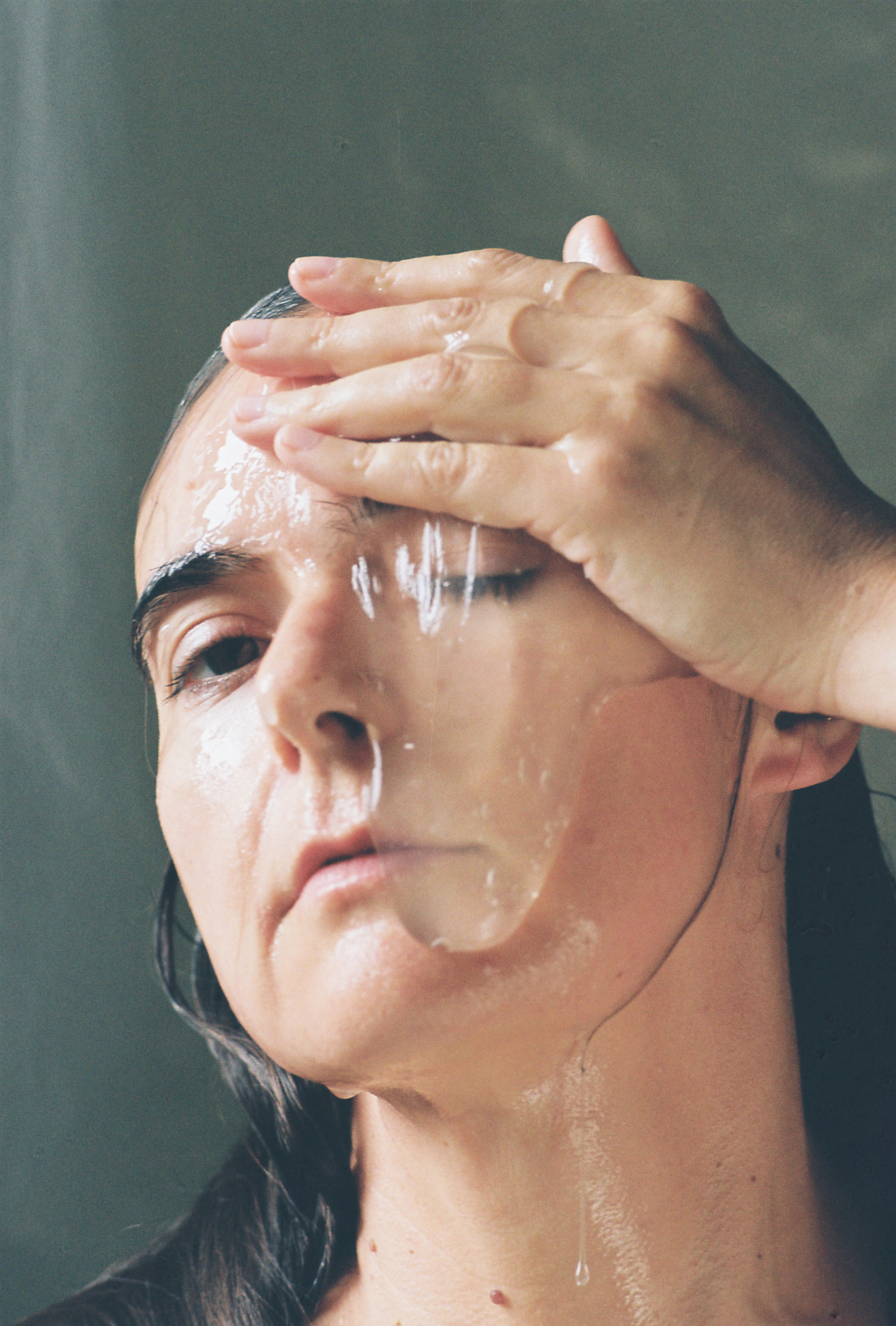
Slime is neither liquid nor solid. I’m fascinated by this ambiguity. It makes the boundaries of the body fluid, opens them up and, for me, represents connection. We humans are also born slimy. Over the course of our lives, we often lose touch with this slimy, fluid origin. Yet we are, in fact, very fluid, permeable beings.
For me, slime is above all about entering into fluid contact that dissolves boundaries. Through its streaks and threads, it creates connections between us. At the same time, slime also functions as a kind of selective barrier within our bodies. I’m fascinated by these different functions. There is hardly any form of life that exists without slime. It’s an incredibly fundamental substance. What fascinates me more and more is how strongly slime resists binary thinking: through its ambiguity, its constant flow and its ongoing transformation.
Another aspect is that slime challenges me as a choreographer because it is uncontrollable. It reacts differently depending on the temperature or the consistency of the water. It’s like a co-performer that behaves differently every time, and I have to respond to it in the moment. It resists choreographic reproducibility.
I have to engage with it anew every time. That’s precisely what interests me in relation to the audience, too: the idea of collectively engaging with a substance, with a quality, that is unpredictable. We don’t know how it will behave. But by coming into contact with this unpredictability, we have to adapt – and in doing so, we can evolve.
For me, this also has a strong connection to Donna Haraway and her idea of making kin, of creating connections with non-human forms of life. Slime allows the body to expand and opens up possibilities for forming connections with non-human organisms.
Slime can provoke very different reactions – from disgust to fascination and even desire. What do these different sensations and audience responses mean to you?
Yes, it evokes disgust, but also curiosity. It’s a kind of curiosity we also know from childhood. There’s a great fascination with this substance, partly because it’s so tactile. You want to touch it, while at the same time you realise that it’s unfamiliar and defies your expectations. We rarely come into contact with substances like this.
In our technologised, progress-oriented world, wetness is generally something we try to avoid. We’re supposed to be dry and sterile, for instance, so that we can operate technology. We emerge from the womb, are washed, dried and dressed. From that moment on, we spend much of our lives trying to stay as dry as possible: not to sweat, not to smell, and to maintain a certain form of sterility that we’ve been conditioned to accept. I think there’s a particular kind of pleasure in reconnecting through slime with something that has always been part of us.
‘The one-to-one format allows for an incredible sense of connection between two people and a certain intimacy. It creates a very particular way of relating to one another.’
Let’s talk about the one-to-one format in which Gootopian Treatment is presented at brut. What changes for you when you meet someone entirely on their own? What possibilities emerge from this encounter?
The one-to-one format allows for an incredible sense of connection between two people and a certain intimacy. It creates a very particular way of relating to one another. Of course, you can also withdraw from this encounter; you are always free. But it’s a completely different situation from being in a room together with a group of people. For the first time, I can give my full attention to just one person in the audience. And I’m curious myself about what this will do to me. I can’t anticipate that yet, but something will certainly happen or emerge.
I find this quality particularly interesting at a time when everything often seems to be about maximisation. I also appreciate the possibility of connecting with someone who is physically present in the room with me, rather than connected virtually. The fact that this encounter involves touch, slimy touch and a sense of connection makes perfect sense to me. It may sound simple, but for me it’s incredibly complex: we enter into fluid, moist contact. We open ourselves up to one another.
What are you particularly looking forward to in these encounters? Is there something you think will be exciting, something you’re especially curious about?
Of course, it’s a particular challenge for me as a performer to connect with 99 people one after another. It’s a durational performance, perhaps even a form of trance – something that continues over several hours and will inevitably challenge me and have an effect on me, too. The 99 individual slots mean that I get to open myself up to each person in turn. That’s what I’m particularly looking forward to: the possibility that this person and I will enter into a state of openness in which we can truly encounter one another and share an experience we won’t forget.
Ultimately, it’s about having experiences that affect us, create a certain intensity and stay with us. We leave the room, we leave brut understage, but we carry the experience with us. I hope that’s what happens – that we have an encounter that resonates beyond those 15 minutes. That I, too, will carry something of that person with me, and that they will carry something of me, or at least of this experience: this moment of contact, this opening up and perhaps also the trust we’ve been able to build together.
Thank you for such a lovely closing thought. And thank you for your time, Doris. We’re already very much looking forward to having you at brut next week with Gootopian Treatment.
25–29 Nov
Doris Uhlich Gootopian Treatment
in the frame of the festival BOOM TSCHAK: 20 Jahre Doris Uhlich


27–28 Nov