brut is a production and performance venue for the performing arts in Vienna and, since its founding in 2007, has been one of the defining venues of the independent performance, dance and theatre scene. The brut programme is characterised by experimentation and interdisciplinarity, showcasing the diversity and variety of the independent scene. In addition to productions in the theatre space, brut Wien also realises site-specific projects and focuses on artistic creative processes, dialogue with the city, collaboration with neighbouring art disciplines and theoretical reflection, whilst playing a pioneering role in the field of accessibility in theatre.

Numerous independent artists from Vienna and Austria have been accompanied by brut as a co-production partner for many years. A good share of brut’s productions are international co-productions touring prestigious festivals and venues across Europe. Vice versa, brut enriches and stimulates the Viennese scene by inviting international guest performances, realising co-productions with artists from all over Europe, and committing itself to continuous engagement in EU networks.

History

Künstlerhaus: From exhibition venue to independent theatre
The Vienna Künstlerhaus was built in 1868 to be a centre for social gatherings and exhibitions for Austria’s oldest still existing association of artists. Beginning in 1882, the historical building from the times of the Vienna Ring Road style was enhanced by two side wings to create the space needed for the first big international art exhibition to take place there. In 1949, a cinema was opened in the left side wing, originally called the German Hall. More than 20 years later, in September of 1972, the building’s right wing, once the French Hall, was rented out to establish a theatre venue. Until 1985, the right wing of the Künstlerhaus accommodated the Komödiantenhaus-Theater. In 1987, an initiative to re-open the theatre as the Political Stage of Künstlerhaus foundered on the decision of the then city councillor for culture, Ursual Pasterk, to instead open the venue to all independent companies along with another vacant venue at the Vienna Concert Hall (Konzerthaus), under the common name dietheater.
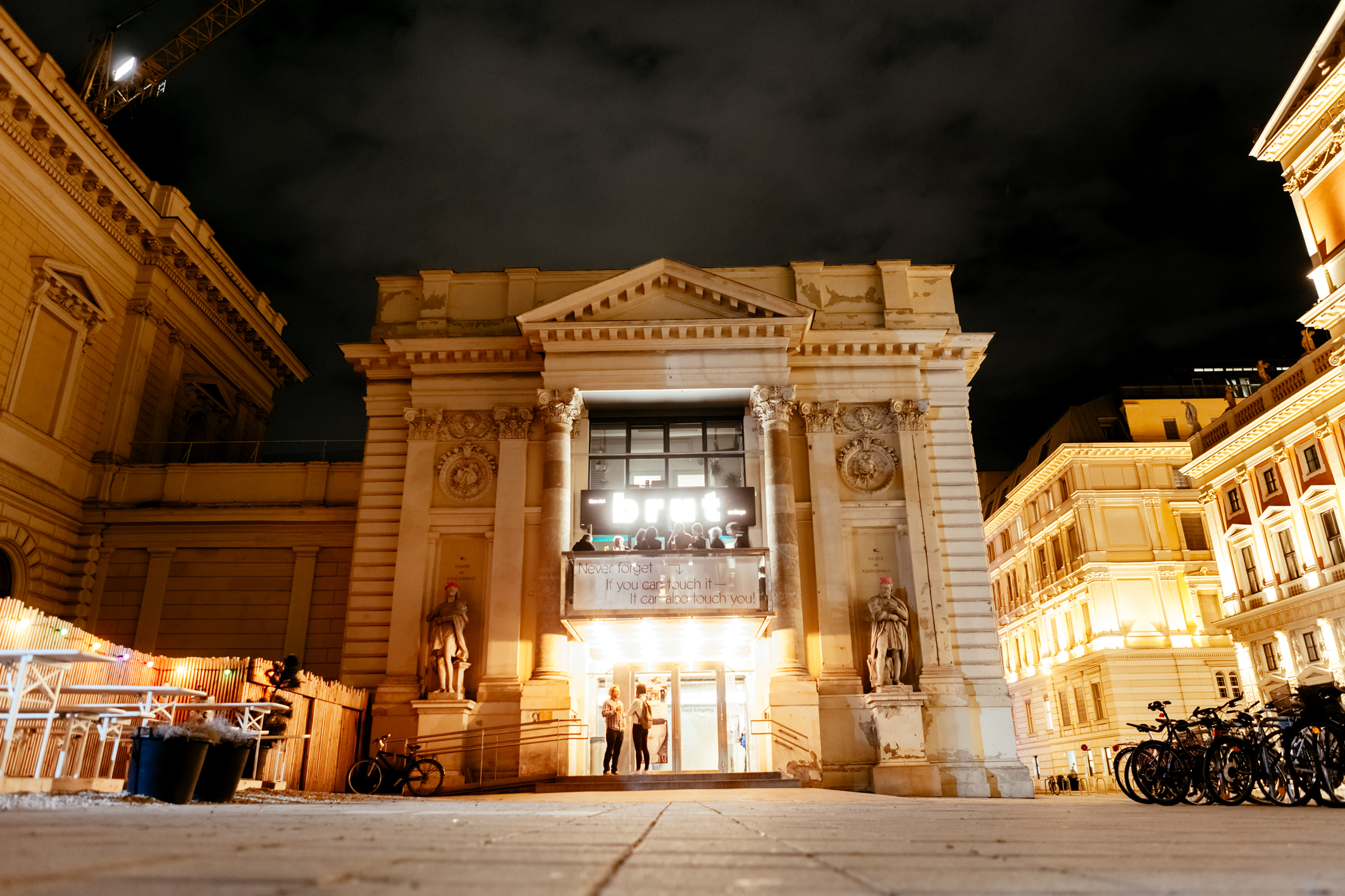
A night-time exterior view of a historic building with a brightly illuminated façade. In the centre above the entrance, a glowing sign reads “brut”. Several people are visible on a balcony and in front of the entrance. Below the sign, a banner reads “Never forget / If you can touch it – / It can also touch you!”. Bicycles are parked on the right, while on the left there is a fenced-off area with a wooden barrier and large planters. The sky is dark and the surrounding buildings are warmly lit.
Künstlerhaus
© Christine Miess
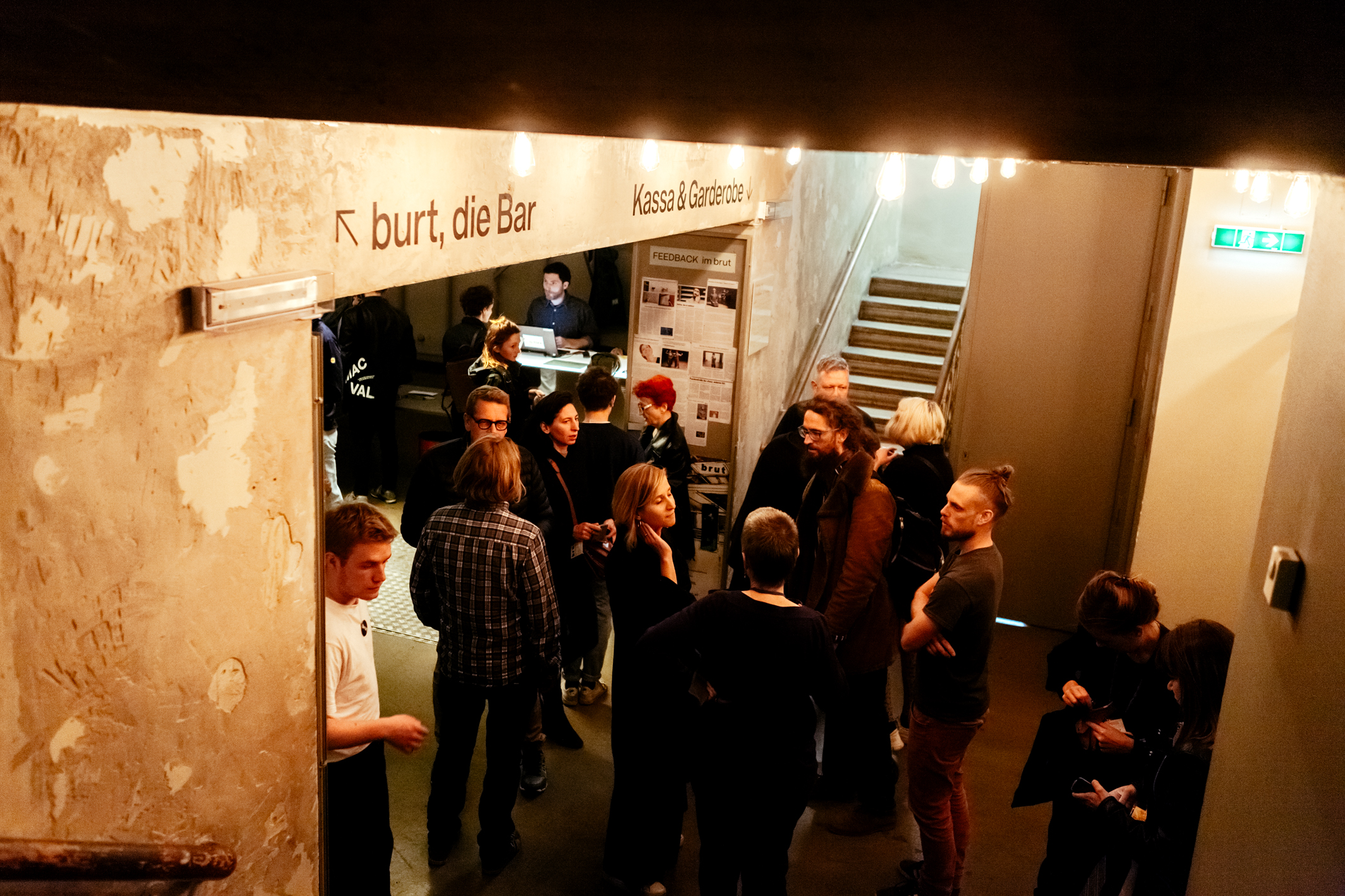
A view from above into a warmly lit foyer or stairwell. Several people stand in small groups, talking or waiting near an entrance. Directional signs on the wall read “brut, die Bar” with an arrow pointing left and “Kassa & Garderobe” with an arrow pointing down. In the background, there is a small box office or information desk with a laptop, next to a poster headed “FEEDBACK im brut”. The walls look raw and partly worn, with exposed light bulbs hanging above. Stairs lead upwards on the right, next to a green exit sign.
Künstlerhaus – Foyer
© Christine Miess
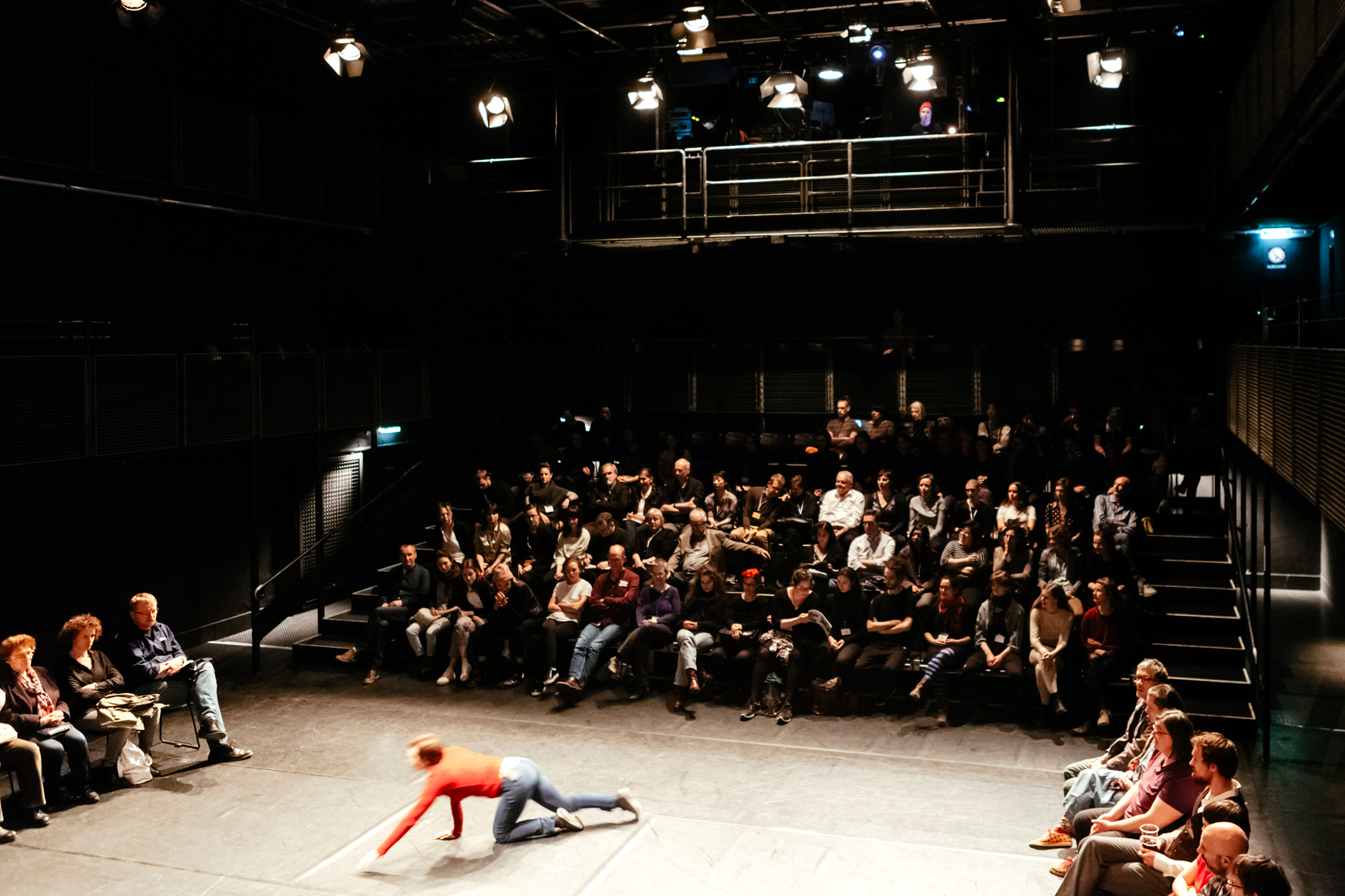
A high-angle view into a dark theatre space with a black floor, tiered seating and an upper gallery. Many people are seated in the audience and around the edge of the performance area. In the brightly lit centre, a person wearing a red top and jeans moves low across the floor, one hand stretched far forward. Several stage lights hang above the scene, illuminating the space selectively while the walls and upper areas remain almost completely dark.
Künstlerhaus – Hall
© Christine Miess
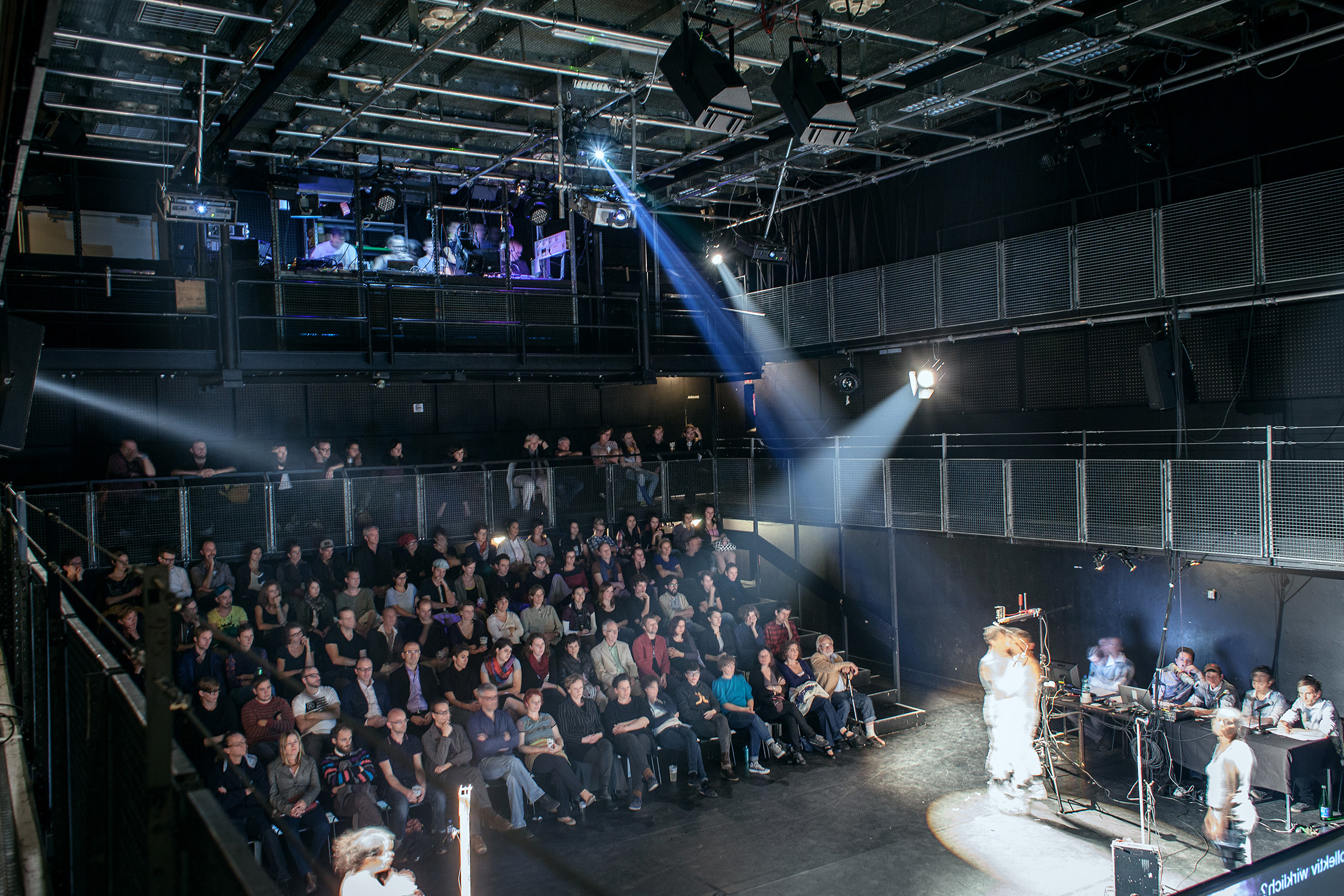
Weiter Blick in einen dunklen Theaterraum im brut im Künstlerhaus. Das Publikum sitzt dicht gereiht auf Tribünen und Galerien rund um die Spielfläche. Auf der rechten Seite ist eine hell beleuchtete Performance-Situation zu sehen: Eine Person bewegt sich im starken Scheinwerferlicht, daneben stehen Tische mit Technik, Kabeln, Mikrofonen und mehreren sitzenden Personen. Von oben und von den Seiten fallen Lichtkegel in den Raum, während Decke, Wände und Galerie in Schwarz gehalten sind. Die technische Ausstattung, Scheinwerfer, Lüftungselemente und Metallgeländer sind deutlich sichtbar.
Künstlerhaus – Hall
© Florian Rainer

dietheater: A stage for the independent theatre scene
As a common umbrella for the Künstlerhaus and the Konzerthaus theatres, dietheater was established on 31 January 1989 as a sponsor organisation for the Wiener Theaterverein, with Christian Pronay as the artistic director and manager. From 1989 to 2007, dietheater presented the works of independent Austrian theatre companies, predominantly showing productions by Vienna-based artists. In addition, dietheater’s annual imagetanz festival provided an important forum for the Vienna dance scene.

brut Wien: The founding of an international co-production house
In the summer of 2006, the Theaterverein Wien placed a call for applications to find a new artistic director for the two venues at Künstlerhaus and Konzerthaus. The founding artistic directors of the institution now named brut were Thomas Frank and Haiko Pfost, whose directorship was characterised by the restructuring of brut into an internationally oriented co-production space for the independent performance, dance and theatre scene. From 2007 to 2015, numerous Austrian productions were developed, presented and organised at brut, accompanied by international guest performances as well as concerts and parties.

brut all over Vienna: The whole city becomes a stage
From autumn 2015 until the end of the 2025/26 season, Kira Kirsch took over as Artistic Director. Following the move out of its main venue at the Künstlerhaus in 2017 due to a complete refurbishment, brut focused mainly on staging productions at various temporary venues, site-specific projects, dialogue with the city, process-oriented work and collaborations with institutions from related disciplines. Under the slogan brut all over Vienna, brut staged performances at around 100 venues across 19 Viennese districts. In addition, brut carried out a complete refurbishment of the venue at Zieglergasse 25 in the 7th district and renamed it studio brut. From March 2021 until the end of the 2025/26 season, brut Wien was based at Nordwestbahnstraße 8–10 in the 20th district, transforming the temporarily repurposed industrial hall into a vibrant theatre space known as brut nordwest.
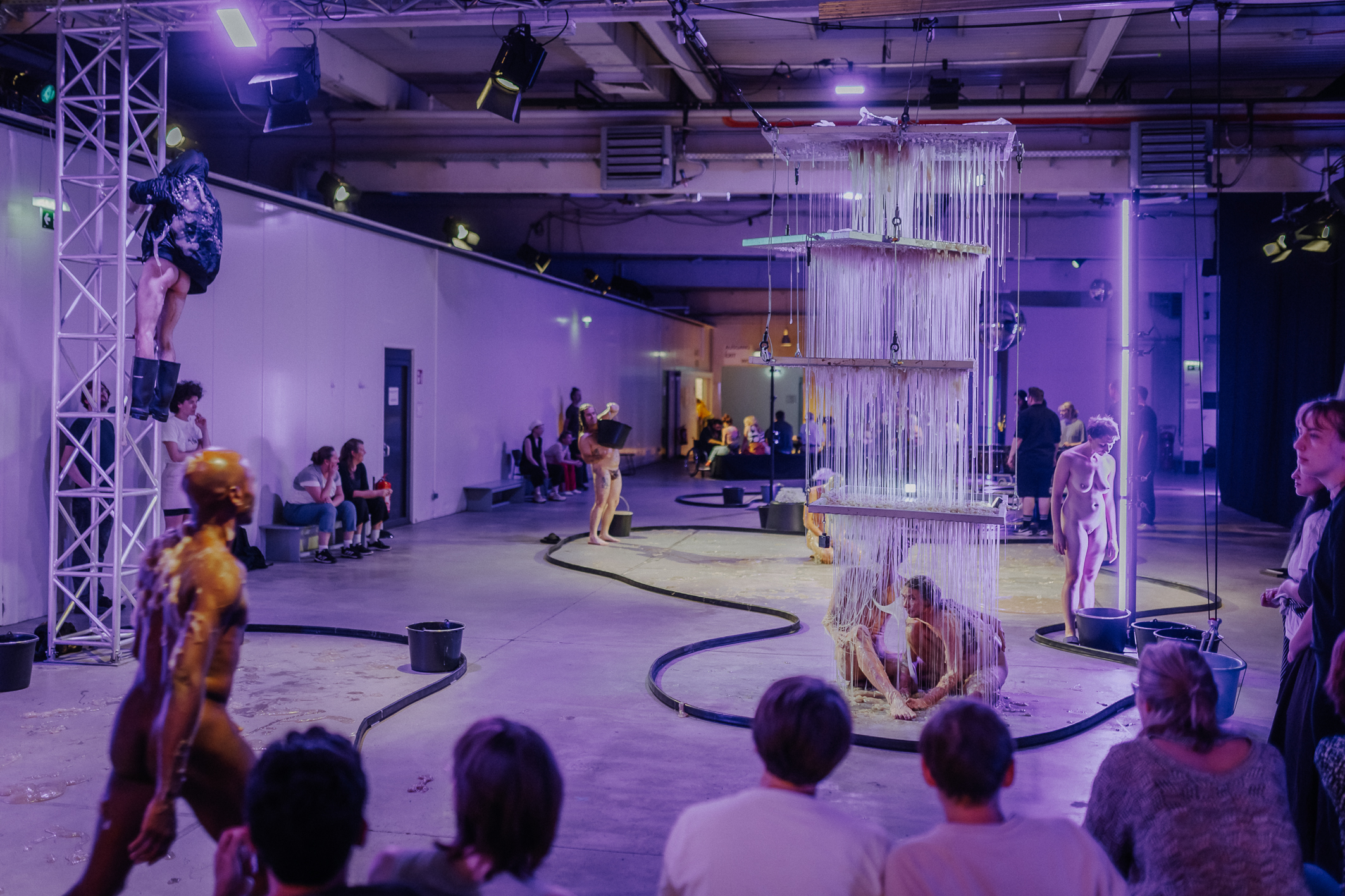
Wide shot of a performance installation in a large hall with purple lighting. Several performers move among the audience, black hoses, buckets and a tall suspended structure with long, thread-like strands hanging down. The audience sits around the performance area, watching from close range.
Doris Uhlich – Gootopia – The Treatment (2023/24, brut nordwest)
© Christine Miess
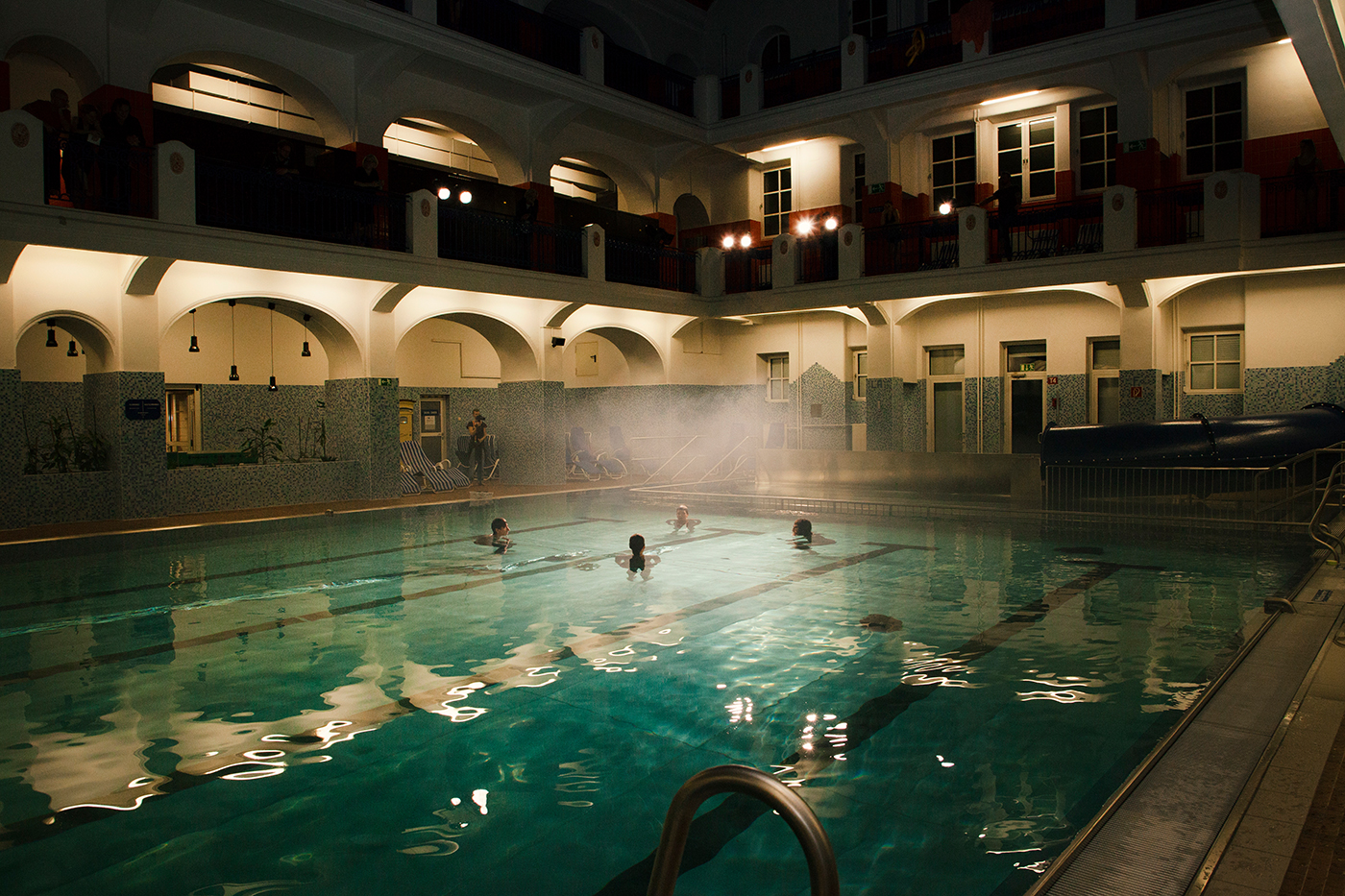
Interior view of a historic swimming pool in dim light. Several people are in the water, while mist hangs over the pool and individual spectators stand on the surrounding balconies and by the poolside.
Oleg Soulimenko – Swimming Pool, 2017/18, Jörgerbad, 1170 Vienna
© Franzi Kreis
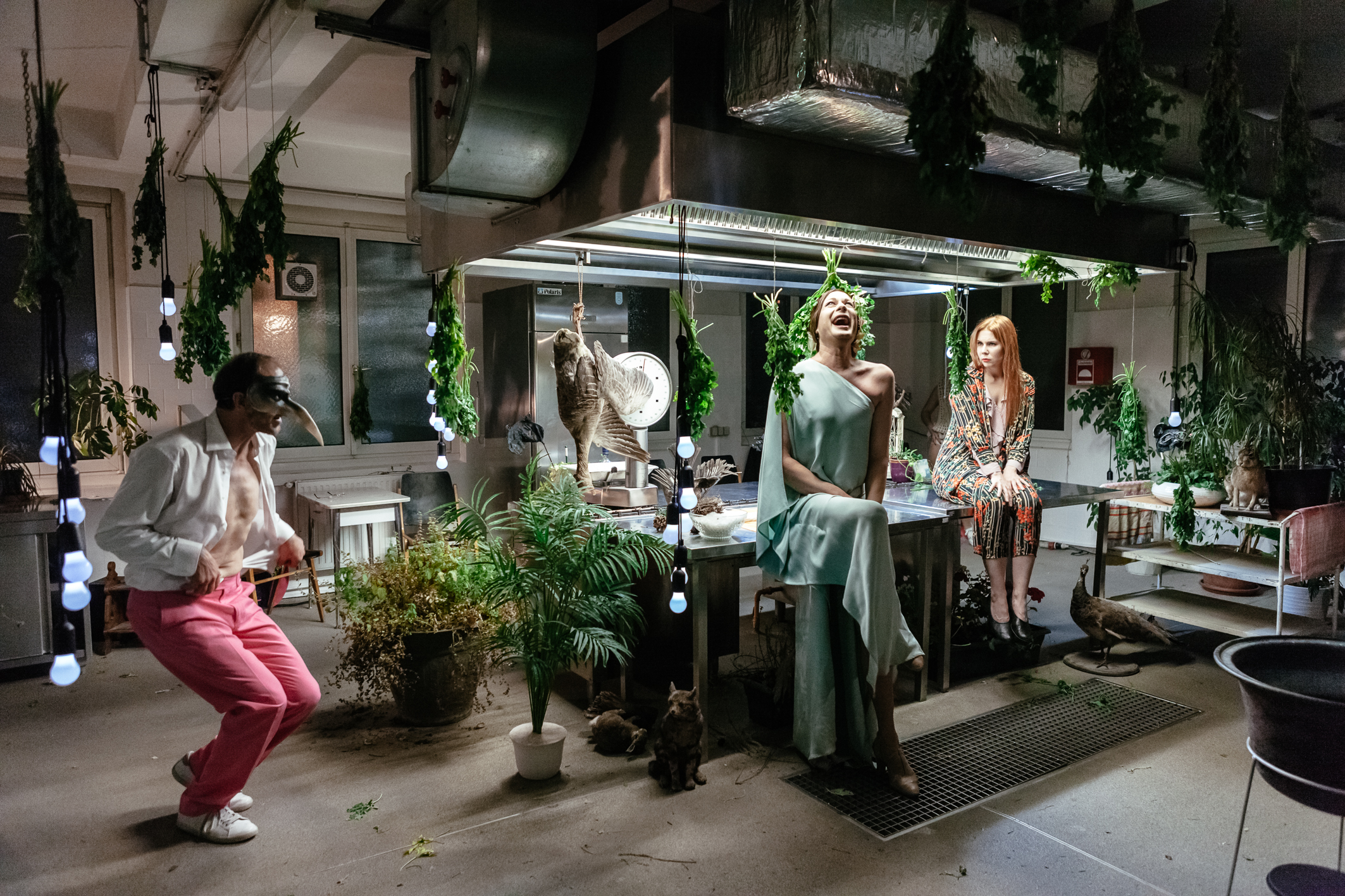
Theatrale Szene in einem küchenartigen Raum mit vielen Pflanzen, hängenden Glühbirnen und Tierpräparaten. Drei Performer*innen sind zu sehen: links eine Person mit langer Schnabelmaske, offenem Hemd und rosa Hose, in der Mitte eine lachende Person in hellgrünem Kleid auf einem Tisch, rechts eine Person in gemustertem Anzug auf einer Arbeitsfläche.
Nesterval – Dirty Faust (2017/18, Ehemaliges Waldkloster am Gellertplatz, 1100 Vienna)
© Christine Miess

House of Performing Arts: A new theatre for brut in Neu Marx
In 2019, it became clear that moving back into the Künstlerhaus was impossible due to the steep increase in renovation costs. In September 2020, the question of a new permanent venue was resolved: The City of Vienna is renovating the listed building of the former Central Bank in St. Marx (Karl-Farkas-Gasse 16) in the 3rd district and having it converted for use as a theatre. The first major stage productions as well as the imagetanz festival 2027 are expected to be staged there in autumn 2027. From autumn 2026 until the opening of the new venue at Karl-Farkas-Gasse 16 – the House of Performing Arts – brut will present performances at various temporary venues, primarily in the 3rd district, in the immediate vicinity of the new theatre, and at studio brut at Zieglergasse 25 in the 7th district. In addition, brut has already rented office space at Karl-Farkas-Gasse 18, 1030 Vienna.
Since 2024, Stephanie Höltschl has been the Commercial Director of brut Wien, and in July 2026 Tomasz Kireńczuk took over as Artistic Director.

brut receives its main financial support from the City of Vienna’s Department of Cultural Affairs (MA 7). brut is a non-profit limited liability company (GmbH); the Artistic Director is appointed by the Vienna City Councillor for Culture, acting in an official capacity, on the recommendation of the Vienna Theatre Association.
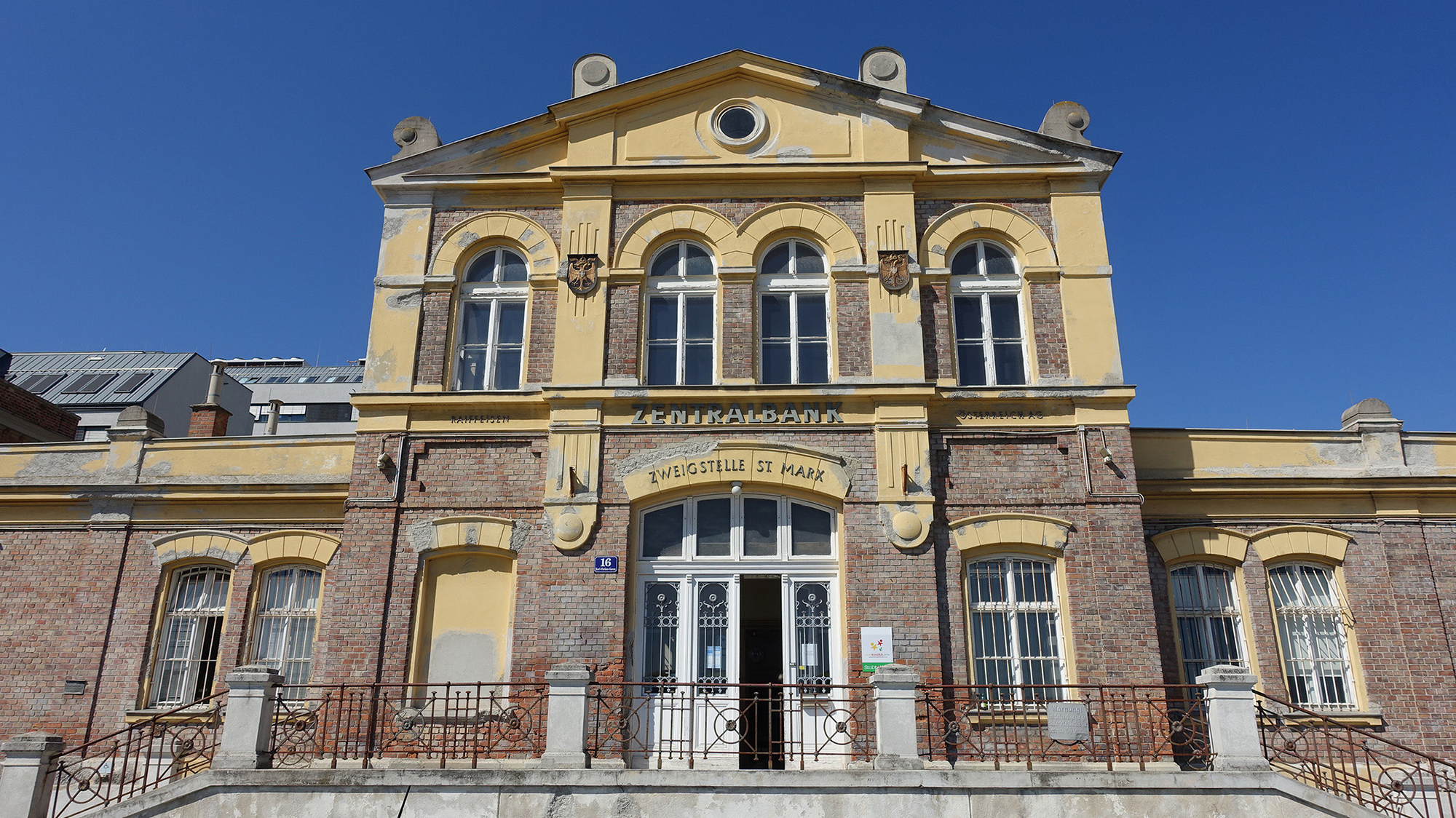
Front view of a historic brick building with yellow façade details under a clear blue sky. Above the main entrance, large letters read “ZENTRALBANK”, with “Zweigstelle St. Marx” written below. The façade features tall arched windows, decorative columns, crests and a small round window in the gable. A metal railing, raised terrace and several barred windows are visible in front of the entrance. Parts of the façade appear weathered, with visible patches of plaster and areas in need of renovation.
Karl-Farkas-Gasse 16 (2020)
© brut Wien
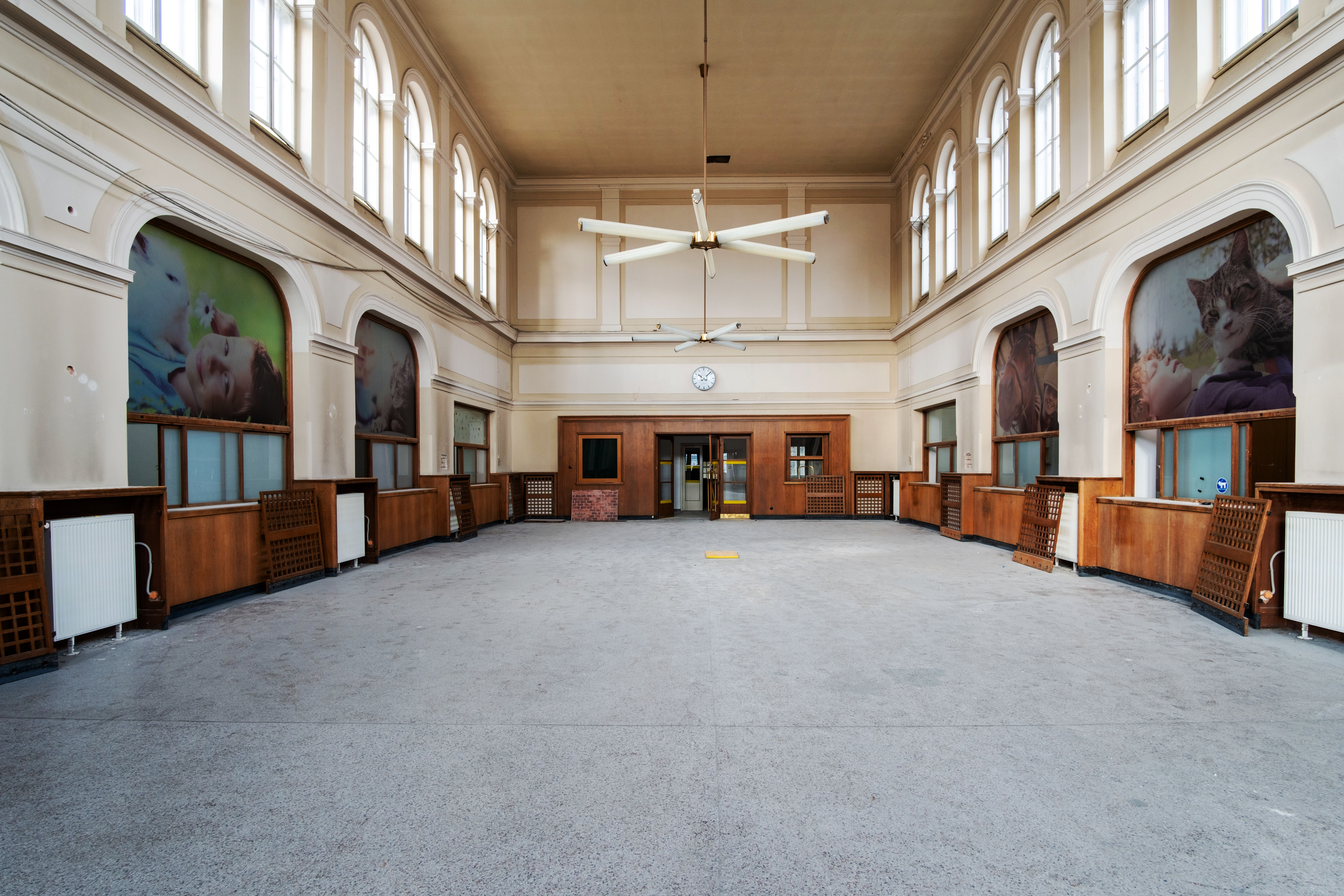
View into a large, empty interior with a high ceiling, light-coloured walls and many tall arched windows on both sides. Dark wooden panelling, radiators and large framed image panels with animal and human motifs line the walls. A modern light fixture hangs from the centre of the ceiling; further back, a clock is mounted above a wooden wall with doors. The grey floor is open and spacious, giving the room a quiet, bright and unused atmosphere.
ehemalige Schalterhalle des Bankgebäudes Karl-Farkas-Gasse 16 und zukünftiger Saal des brut Wien (Oktober 2025)
© Maximilian Pramatarov
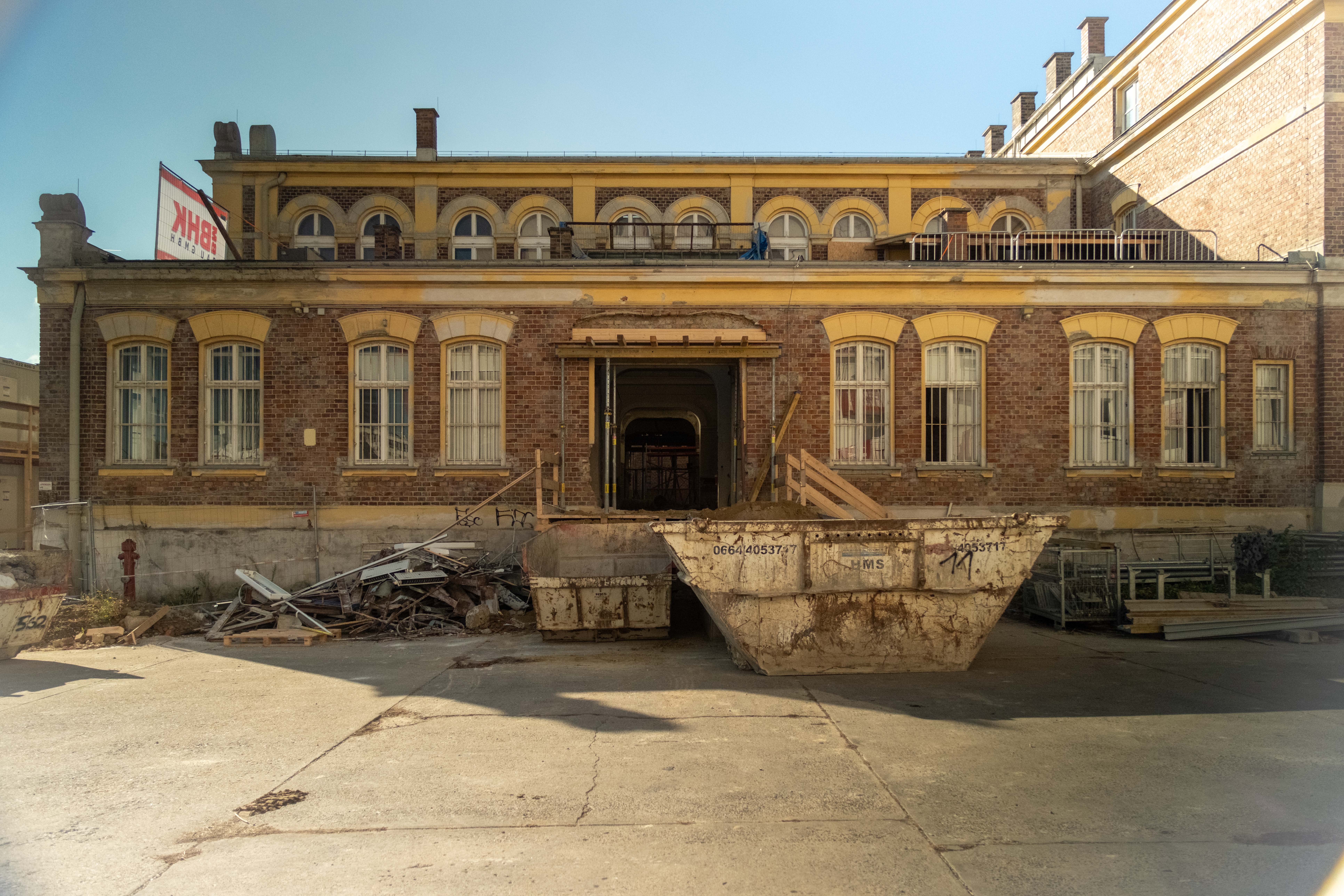
Exterior view of a historic brick building on a construction site. The façade has tall windows with yellow arched details and an open central entrance. Large dirty construction containers, wooden barriers, metal parts and building materials stand in front of it. On the left, a construction sign reads “BM BHK Bau GmbH”. The building appears to be undergoing renovation: parts of the façade are weathered, the entrance area is temporarily secured, and the courtyard is filled with construction material.
Side view of Karl-Farkas-Gasse 16 (November 2025)
© Maximilian Pramatarov
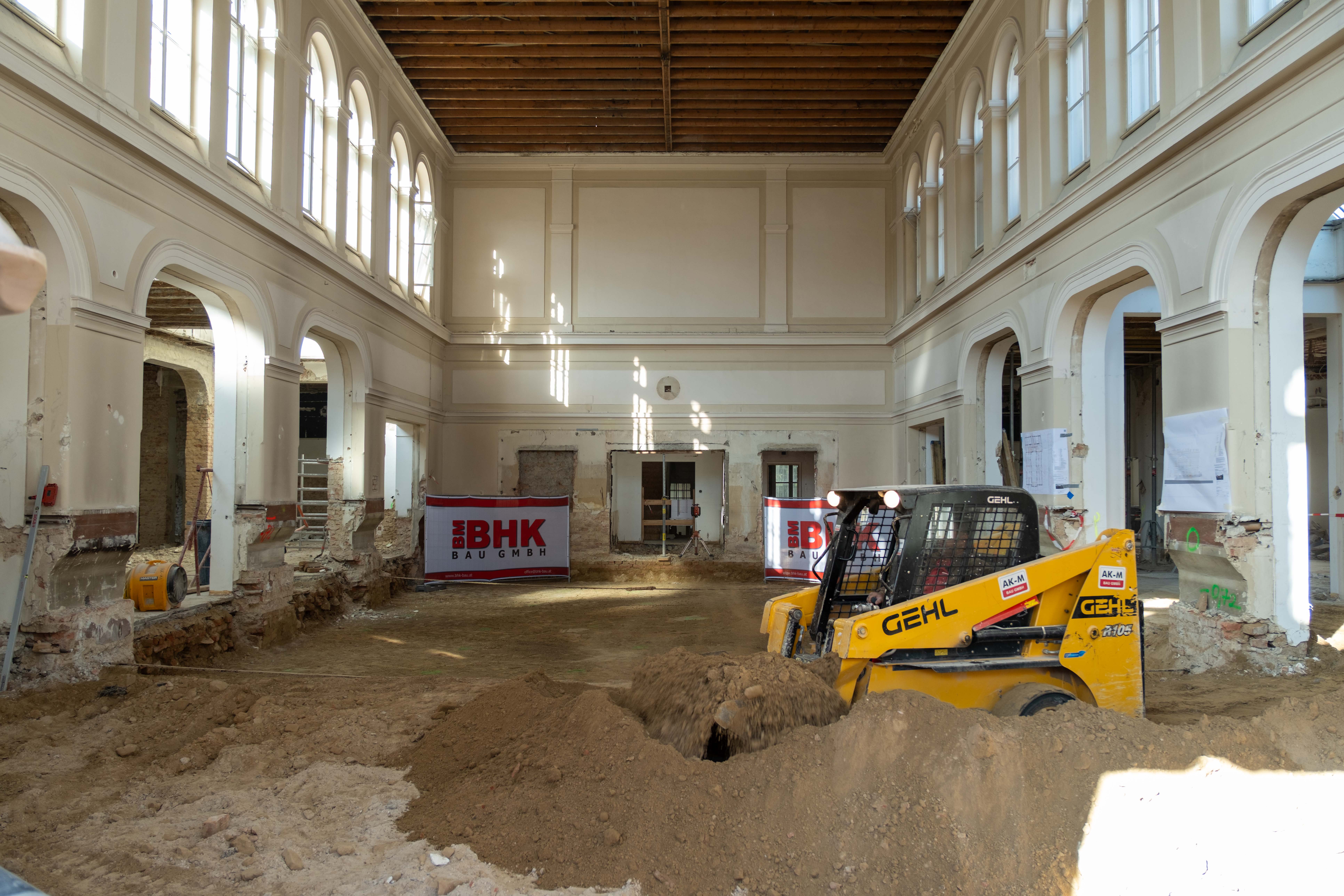
View into a large historic interior during renovation. The room has high walls, large arched windows on both sides, open wall passages and an exposed wooden ceiling. Parts of the walls and columns have been stripped back, revealing brickwork and plaster. Piles of earth and construction traces cover the floor. A yellow GEHL compact loader stands on the right; in the background, two construction banners read “BM BHK Bau GmbH”. Bright daylight enters through the windows, illuminating the raw, spacious room.
ehemalige Schalterhalle des Bankgebäudes Karl-Farkas-Gasse 16 und zukünftiger Saal des brut Wien (November 2025)
© Maximilian Pramatarov
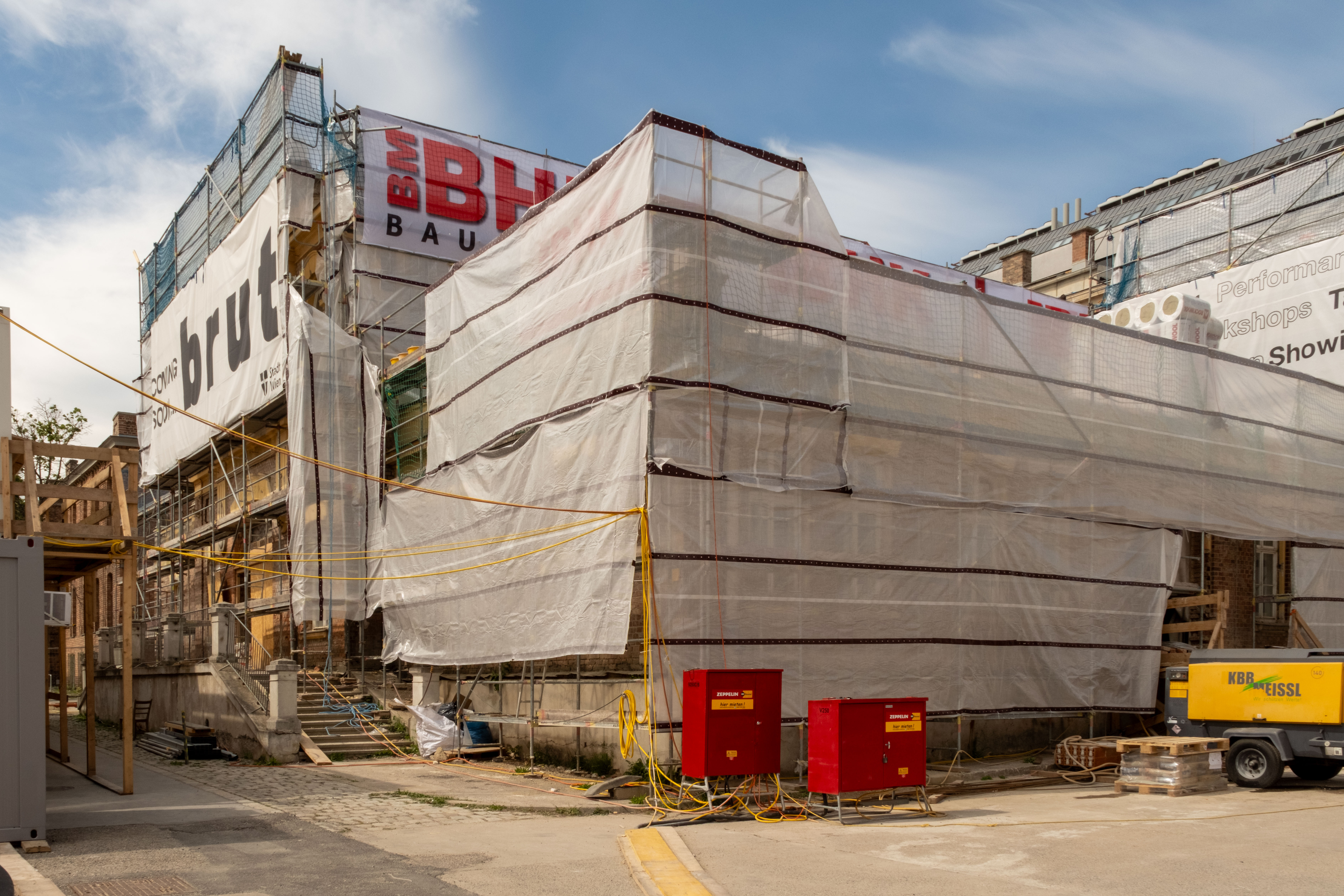
Exterior view of a construction site at KFG16. A historic building is largely covered with scaffolding, netting and light-coloured protective sheeting. Several tarps show large lettering, including “brut” and “BM BHK Bau”. Yellow cables stretch across the construction area; red power boxes, construction equipment, pallets and other materials stand in front. Parts of the brick façade and neighbouring buildings are visible in the background. Above the site, a blue sky with bright clouds can be seen.
Exterior view of Karl-Farkas-Gasse 16 (April 2026)
© Maximilian Pramatarov
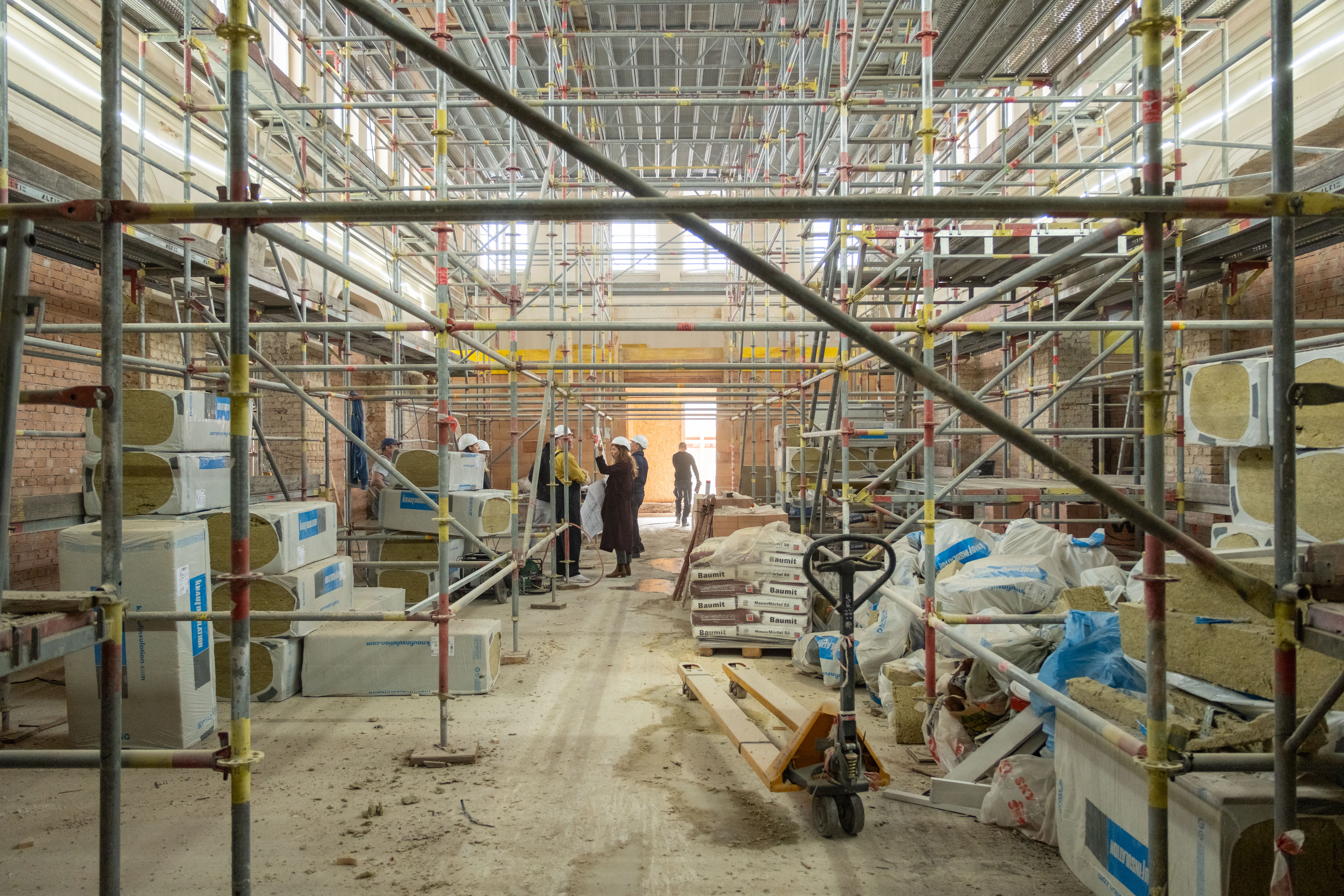
View into a tall historic interior during renovation. The entire room is densely filled with metal scaffolding reaching from floor to ceiling, forming a grid of horizontal, vertical and diagonal poles. Raw brick walls, high windows and partially exposed wall surfaces are visible on both sides. Insulation material, construction bags, pallets, cables and tools lie on the floor; a pallet truck stands in the foreground. In the centre of the room, several people wearing hard hats are talking to each other. Daylight enters through a bright opening at the far end, illuminating the dusty construction site.
ehemalige Schalterhalle des Bankgebäudes Karl-Farkas-Gasse 16 und zukünftiger Saal des brut Wien (April 2026)
© Maximilian Pramatarov
Back to top