

Magazine
Fragile Timing, Pointed Play: On the Practice of Sunggu Hong
A text by Freda Fiala
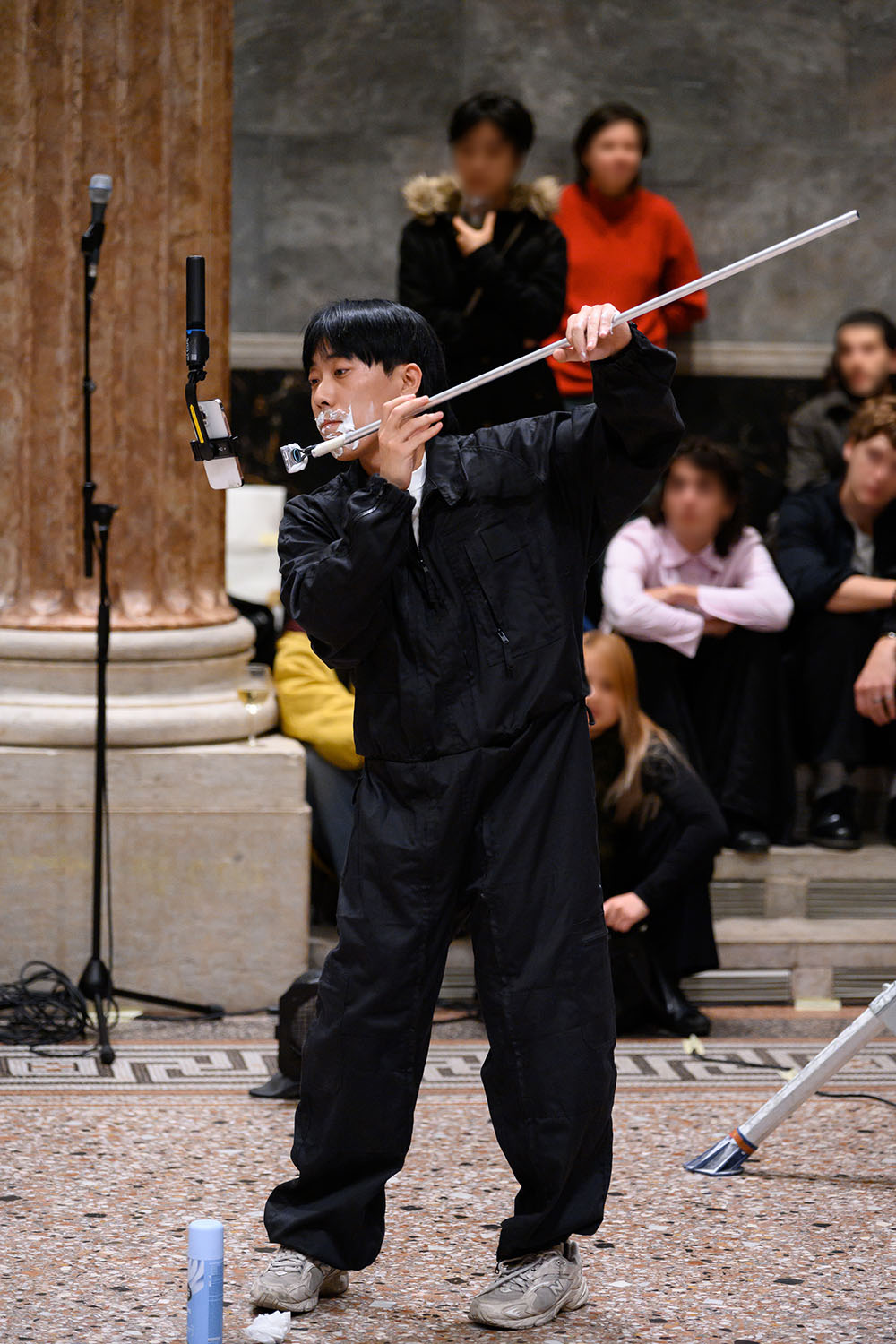
Sunggu Hong’s performance practice begins where the human stops pretending to be the main character. His worlds are full of animal doubles, robotic companions, cardboard signs, plants – artificial limbs of attention that seem to have migrated from a toy shop, a botanical archive, a colonial greenhouse, and a haunted flat share all at once. They are cute, but never harmless; they offer play, but no absolution. Working between installation, live performance, and performative experiment, Hong lures us into environments where togetherness is a sticky business of dependency, projection, misrecognition, care, extraction, and the strange labor of becoming legible to another being.
Artists
Sunggu Hong
Sunggu Hong, born in Seoul, is a Vienna-based artist working in visual and performing arts. He studied performative art at the Academy of Fine Arts Vienna. ‘Relation’ forms a central concept in his artistic practice. Starting from this, he asks how we can or should live together within interdependent, entangled, and complex relationships, and why exclusion and hatred emerge within these complex relations.
Hong operates with a pointed randomness, as if he has spent weeks rehearsing a specific accident. The humor is dry, physical, and wonderfully awkward. His practice is research-based, but not explanatory. It tests, stages, rearranges, listens, waits, interrupts. It is not chaos, but a fragile, heightened receptivity to everything the rest of us have been trained to ignore.
A useful term might be relation, though only if the word is rescued from its polite reputation. In Hong’s work, it means mutual exposure with an almost silent punchline. The subject does not arrive at the scene as a sovereign, finished unit; it is squeezed into existence by the encounter itself. This is not lukewarm diplomacy. It is a friction-filled inventory of the asymmetrical, the strange and the embarrassing. Relation is the clumsy mechanism through which one becomes visible – and the precise trap through which one is inevitably misread.
These stakes have roots in Hong’s early formation. During his studies in Seoul, he approached people living on the streets, marked as homeless and socially excluded. In South Korea, homelessness is often read as a rupture in normative orders of family, labor, and belonging. In an early gesture that remains ethically difficult, and knowingly so, Hong temporarily presented himself as homeless and lived on the streets with the people he was trying to understand. His work does not resolve the discomfort of that act. Instead, it asks what it means to claim a social role, whether authenticity can be separated from performance, and what conditions make understanding possible at all.
After moving to Austria, Hong continued this practice at the University of Arts Linz and, from 2021 onward, in the Performative Kunst Klasse. Collaborations with So Young Park, June Hwajung, and, more recently, Lens Kühleitner, sharpen his grammar of performance; as made and remade between bodies, objects, stories, and atmospheres.
Hong’s more recent works reach into East Asian history and family memory. In Raised by the Chronic; Beyond, the Moth (2026) and Slough-ing off; Orbit of Otherness (in development) he approaches the force of personal relations as encounters with the “Other”. Both works revisit memories of his grandfather, born in Japan, and yet, against the background of Korea’s colonization by imperial Japan, spoken of within the family simply as “Korean” – touching the silence inside naming: what is transmitted when history is not explained, but folded into speech? Across Hong’s practice, one senses a Beckettian distrust of language. Words arrive late, stumble, fail, repeat. When language cannot solve relation, Hong hands the stage over to reaction: movement, proximity, sound, delay, malfunction, and things that do not speak but insist.
Spatial arrangements, often developed with collaborators, enact a decentered ontology of co-constitution. Walls and floors are approached with the dignity of kin, stirred into relation by breath and movement. Everyone and everything arrives as a guest from elsewhere but may be held in a softness that honors their journey. In his work, thinking isn’t a distant interpretation; it’s a vivid, unstable negotiation with things that only look harmless until they begin to matter.


